
“I want confessions! Not corpses!”
MARK OF THE DEVIL

Who made it? Directed by Michael Armstrong | Written by Adrian Hoven & Michael Armstrong | Director Of Photography Ernst W. Kalinke | Special Effects (not credited)
Who’s in it? Herbert Lom | Olivera Vučo | Udo Kier | Reggie Nalder | Herbert Fux
If you weren’t watching this the week it came out, you might have been watching…
Patton | M*A*S*H | Airport | Zabriskie Point |
Production notes and whatnot
https://en.wikipedia.org/wiki/Mark_of_the_Devil_(1970_film)
https://www.imdb.com/title/tt0065491/
What’s it all about?
What we have here is an old timey medieval-style crucifix and cackling period shocker. If I was to say a loose “Witchfinder General-ly” set of speeches, trials and jailings had been stapled together as an excuse for some violent tortures, screaming maidens, bloody set-pieces and old-worlde iron devices of pain, then I feel I’d be on the money. Racks first, questions later.
We open serenely, with a cart full of harmless nuns. A gentle “Little House On The Prairie” aesthetic, only to be slammed in the face with some good old bright yellow teutonic type-facery, proclaiming MARK OF THE DEVIL. It’s that bold sudden war-film opening, reminiscent (in my memory at least) of old Lew Grade movies and stuff like Guns Of Navarone or Where Eagles Dare. The name Herbert Lom appears. And if your my age, or thereabouts, this has a ring of quality to it.
Up until now (and we’re on film 7 of the project) we haven’t really had a “star” as such. Oh, some of the actors may have gone on to be cult favourites or, able to flog their Sharpie scrawl on a b/w 8×4” glossy photo at a Comicon near you. But I think this is the first time I’ve seen a “household name” in one of these. And when I say “household name”, I refer to Lom’s twitchy mania in seven of the eleven Pink Panther crime comedies.
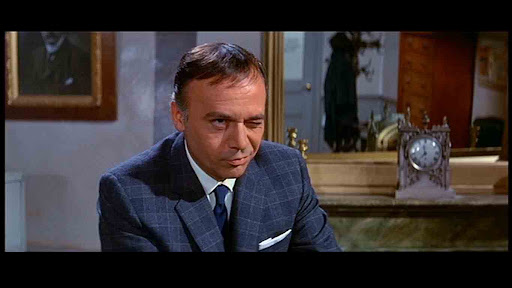
This is pretty much why my generation has heard of him. So to see his name appear in the credits of this was an unsettling treat.
Anyhoo, the nuns continue to trundle and we are clearly in that odd period of history that’s very difficult to put your finger on. Tricorn hats, waistcoats, pantaloons and such. But castles and witches and farmland and urchins. Plus everyone is buxom and in a cape. Let’s say the 17th /18th Century. But it could be 100 years either side of that. And it’s Sunday afternoon and I’m not going to check.
With a whip of a looming fish-eye lens, some bandit types arrive and murder the nuns, which is unpleasant. But let’s you know what you’re in for.
We are in a world of witches and fear, where villagers and councilmen and townsfolk and other types in bright velvet and dusty lace have hangings in town squares. Witch trials are rife and it would seem you don’t have to do much to be cursed and spat at by an “inquisitor” type with a crucifix and promptly tortured in a manner of excruciating ways.
We watch as a chap is tarred and feathered and his hand chopped off. We observe 2 screaming “witches” being burnt at the stake. Crowds cheer and rave like they were Monty Python at a stoning.
Next stop a tavern – of course. Because we’re a few minutes in and no-one has said “flagon” or “meade” yet and nobody has upset a tankard.
We meet some key characters in the sketch: Count Christian, a painfully handsome man with eyes that would make Robert Powell look squinty. Peircing just about does it. He resembles what a test-tube baby would look like if grown from the seeds of Harry Hamlin and Peter Gallagher.
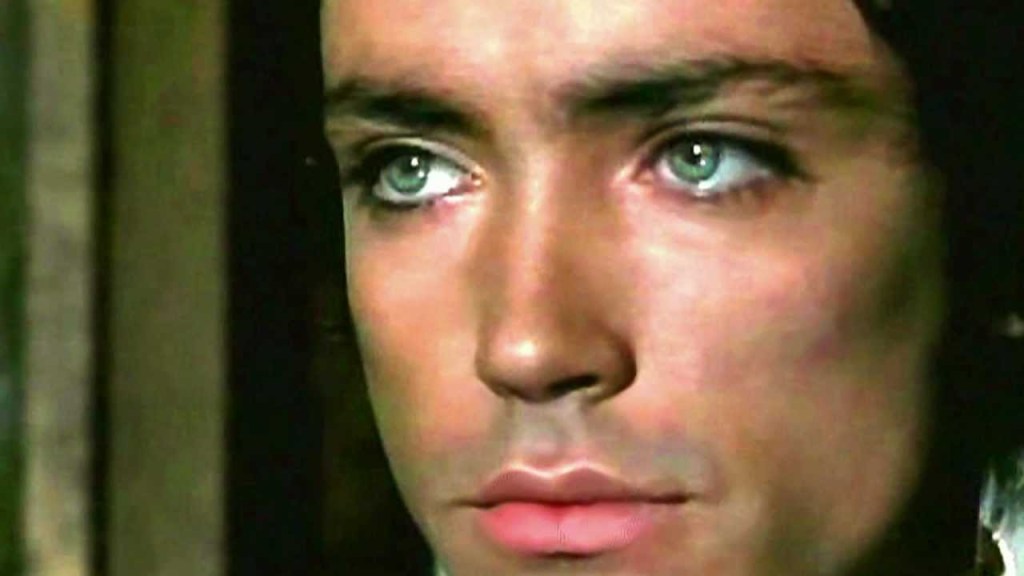
Christian is a “witchfinder in training,” if you like. On an unpaid zero-hours apprentice scheme. He works under the big wig of Herbert Lom’s Lord Cumberland. Pretty much the Philip Green of witch-finding in those parts. He sits carousing and carolling with his chum Herbert, the local executioner fellow.
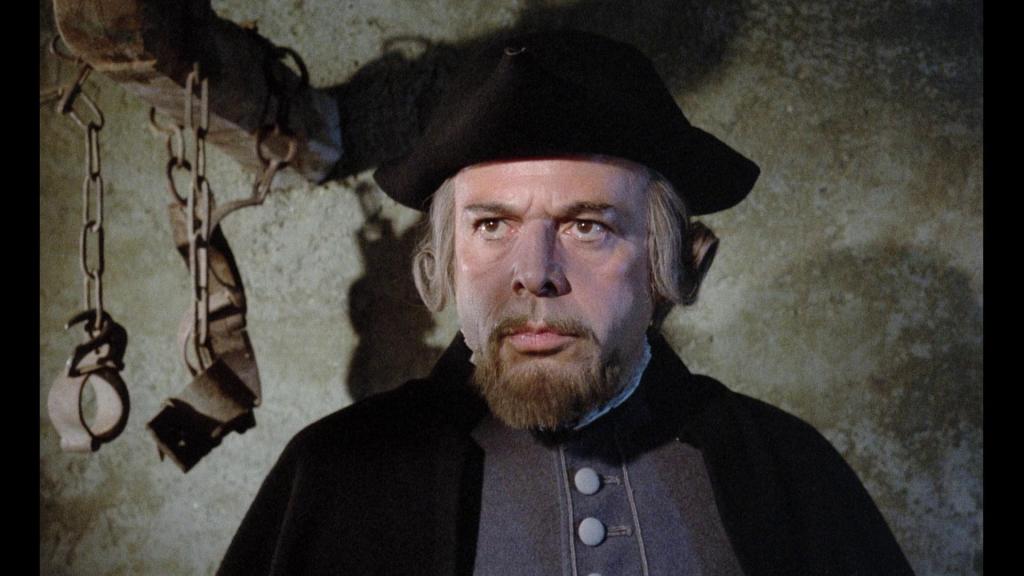
Of course we need some plot after all this set up so the current Witchfinder of the village, Albino, played with gusto by Reggie Nalder, arrives. There is lively discussion over a “proclamation.” We discover that Lord Cumberland is on his way to take over the local “witch-finding” duties. Albino is less than happy.
Now it seems Albino is mainly irritated because he’s got a sweet little gig here. Clearly madder than a box of cheese, Albino has been swanning about, all cassocks and buckley boots, calling all the women witches so he can get his 18th Century rocks off torturing them, raping them and generally behaving like a premier league football player in a hotel. The last thing he needs is Herbert Lom’s ‘Cumberland’ sticking his sausage in the town business and finding out about the corruption and what a Deloitte consultant would probably call “a lack of documented audit trail.”
But arrive Cumberland does, in a manner pre-empting Darth Vader’s swooshy cape action by 7 years. Or long, long after – depending on how seriously you take the Lucas timeline. He also has a menacing looking cane, which gives him something of the Biff Tannen. Cumberland is not impressed with Albino’s documentation or processing. He wants “confessions! Not corpses!”
A quick review of Albino’s work shows he’s been rather slack on keeping receipts and as such, some women are set free with a government apology and a church gift-voucher. One of these young wenchy buxom maidens is Vanessa, who we will discover becomes something of Count Christian’s favourite. They laugh, they run, they dine and eat fruit in a lusty manner. And indeed a lusty manor.
The remaining bulk of the movie follows Christian as he gradually loses faith in Cumberland’s actions. There are only so many innocent women (farmers, puppeteers) he can see put through water torture, thumbscrews, stocks, burning, stretching on a rack, branding with scalding irons, whipping, sat on beds of nails, lowered into a fire, having their eyes cut out, beheaded and, famously, having their tongue ripped out with a clamp, before he loses patience. All in glorious technicolour.

Things come to a head when Albino accuses Cumberland of being a crazy assed sadist who only tortures women to make up for his impotency. Well, you don’t go around accusing Inspector Clouseau’s boss of shooting blanks. So Cumberland gets rightly peeved and strangles Albino.
This is the last straw for Cumberland who is beginning to realise this whole “churchy witchy” plot is really just a way of letting greedy priests and bishops steal gold and land and property from everyone they come across. And then, like it were Paris in 1789, there is a huge revolt.
By which I mean all the extras, dressed as they are like folk off the lid of a Quality Street tin, storm the castle and there is much shrieking and bloodletting and revenge from the townsfolk o’er the corrupt church. And boy do they enjoy getting their hands on the old torture kit. So in a final scarlet flurry of chains and whips and spikes and flaming torches and scissors and sharpened nutcrackers (hoo-boy), there is a glorious overthrowing. Much sunsets and crying and it all goes rather Wicker-Man hysterical. At which point, one assumes, everyone goes home, free of the tyranny of mad priests and thumbscrews, to enjoy a flagon of meade and a buxom velvety wench.
Is it any good?
We’ve taken a step up here, it seems. Certainly from a production and casting and general “let’s try and make a proper film” point of view. Yes, ‘Night Of The Living Dead’ was a sensational masterpiece, but even had a found-footage, newsreel, black and white, art-house project sensibility. Amazing for all that, but clearly made by talented amateurs on a weekend budget.
Michael Armstrong’s Mark Of The Devil is a step up and we are entering the more glossy, expensive, well-lit, lavishly costumed affair. Far from an epic (it has no sweep or majesty, no extensive outdoor sets. No one is going to accidentally tune in and think they’re watching Cleopatra), it could sit quite nicely alongside Zinnemann’s highly regarded A Man For All Seasons in its aesthetic.
A quick check on imdb and we see that Armstrong has a stable of quality and reliable productions on his CV, working as he has with Vincent Price and Christopher Lee (1983’s The House Of The Long Shadows) and some quality knockabout telly (The Professionals, The Return Of The Saint). Fact is, it’s a German funded movie with a top cast of familiar-ish faces, shot on location in a quaint Austrian town with no expense spared on making it look suitably 18th Century and you wouldn’t be embarrassed being caught watching it on your iPad on a bus.
Until the tortures start, obviously.
The production company and producers and distributors absolutely knew what they had when the final processed technicolour reels came back from the chemist. No attempt was made to pass this off as an Oscar winning documentary, a sombre discussion of life in the 1700’s, a moving tearjerker about forbidden love or a hard-hitting expose of some of the Catholic church’s seedier moments. Nope. They knew they had a crowd pleaser, a crowd screamer, a cover-your-face blood riot of sadistic torture of every stripe and variety and packed the audiences in with a marketing campaign claiming “Positively The Most Horrifying Movie Ever Made!” The overstained poster, rather than focussing on the dashing Udo Keir or the gothic goatee of Herbert Lom, shoves the gurning grotesque of Reggie Nadler’s noggin all up in the audience’s grille, plus screaming women and the following hysterical claims: Guaranteed To Upset Your Stomach! The First Film Rated V For Violence! And my personal favourite, ‘Due to the horrifying scenes, no-one admitted without a vomit bag (available free at box office)’.
And what nasty fun doth await the punter and his/her popcorn (hopefully not confused with the bag of vomit halfway through the third reel).
The sets and costumes are on the cheap side, but the locations are real as you like and we get a genuine sense of time and place. It’s real concrete, real rocks, real dust, real stone, real horses. Not a hardboard gravestone or polystyrene altar in sight. The castle used held genuine witch-trials during the period and some of the horrifically rusty torture equipment being waved about the place came from the castle museum and are genuine relics of the age.
The cast, who uniformly do their best to keep menacing straight-faces throughout the thunderous panto bible-bashing, are earning their wages. Much staring, pointing, spitting, scowling and some serious eyebrow work. Campy, yes. But playing it true to the gothic horrors of the material.
There seems to have been plenty of dubbing (possibly over the German, although tales are told of an entirely mixed European cast and crew speaking over half a dozen different languages on set). So if you grew up watching The Flashing Blade on telly during the summer holidays, you’ll get the sense of how it goes.
There are no shortage of all the tropes one expects from this sort of galloping, shouty, purple-robed anger-thon set in these days. Tricorn hats aplenty, waistcoats, doublets, hose, capes and everything has a buckle attached. Like the aforementioned Quality Street tin, the colour has been turned up to eleven so it’s all a bit garish on the retina, but boy when the claret starts to flow, we get some serious ketchup-red squirts.
The music trumpets and thunders and it took me a while of staring off an humming to realise it wasn;t a million miles away from the theme to The West Wing mixed with John Barry’s sweeping score to Dances With Wolves. But not as catchy as either.
As in a lot of movies of this time, the foley artist in charge of sound effects (footsteps, clanks, keys, swishes, hoofbeats and tankards) has whacked his headphones off the scale so every lock, every cup, every horse, every zip sounds like a 12ft chandelier being run over by a milk-float full of coat-hangars. When the jailer gets his huge key ring out, it’s no quieter than Godzilla playing Kerplunk with bits of the Pompidou Centre.
But for all of this, the time romps by. I didn’t check my watch once. For sheer variety of torture methods it can’t fail to hold you interest. Don’t like having bare feet branded? Here’s a rack. Don’t like water-torture? Hold on a second, we’ll burn someone to death in a minute. Too tame? How about a chair full of nails?
Vomit, there was none. It’s 1970s. But bored I was not.
Nasty?
Yes. Thoroughly. Its’ almost the care, expense and gloss that makes it so, rather than the other way around. Being 7 movies in to this project, I have felt until now that the backroom, cheapy, wax/ketchup, animal innards gore of the low-budget meant it felt more…I dunno, nasty. More repulsive, more – somehow – dirty. However when one begins to see what this stuff looks like with expensive prosthetics and decent fake limbs/blood/stumps/wounds, it is a very different experience. Not necessarily more real (movie blood will always be movie blood, movie skin can only ever look like wax or latex – at least in the 60s/70s), but its’ the lingering close-ups that bigger budgets can afford that give the movie a more voyeuristic and downright sadistic layer. We don’t cut away, we don’t whip pan to a scream. We linger. Knives cut, blades tear, wood crishes, irons burn. And because it’s been done with some cost and expertise, the camera hovers around getting all the good bits.
So it’s leery. That’s the word. Leery. “Lom, lecherous and leery”. Which, by coincedence, is also the name of my solicitors
Ban worthy?
Hmn. No. I mean it’s viscious as I say and lingers lasciviously on wounds and burns and scalds and cuts and spurty blood-letting. So it’s gross. And, effects admiration aside, the screaming helplessness of the female victims at the hands of the churchy patriarchy is not a turn on. Unless it is. Then God help you. But it puts the viewer right there next to the inquisitor and invites you to revel in the pain and torture with him. Which is not in the least bit fun. And I can imagine kiddy nightmares of blades and cranks. Don’t ban it. Just keep it on the top shelf.
What does it remind me of?
Ha. Well for the second time around, and it’s the clothes and such more than anything, it’s an X Rated episode of Dogtanian & The Three Muskerhounds. Starring Adam Ant from his pirate flouncy period. All meeting up with Mariam Margoleyes to shout “fornicator!” during Blackadder II. In a butchers window.
Where to find it?
Again, easy to track down this one. Once you have confirmed and proved you’re over 18, the wonders of YouTube’s hidden content (“inner tube” if you like) are accessed and you can get the whole movie for free there.
 letsgetthebannedbacktogether.uk